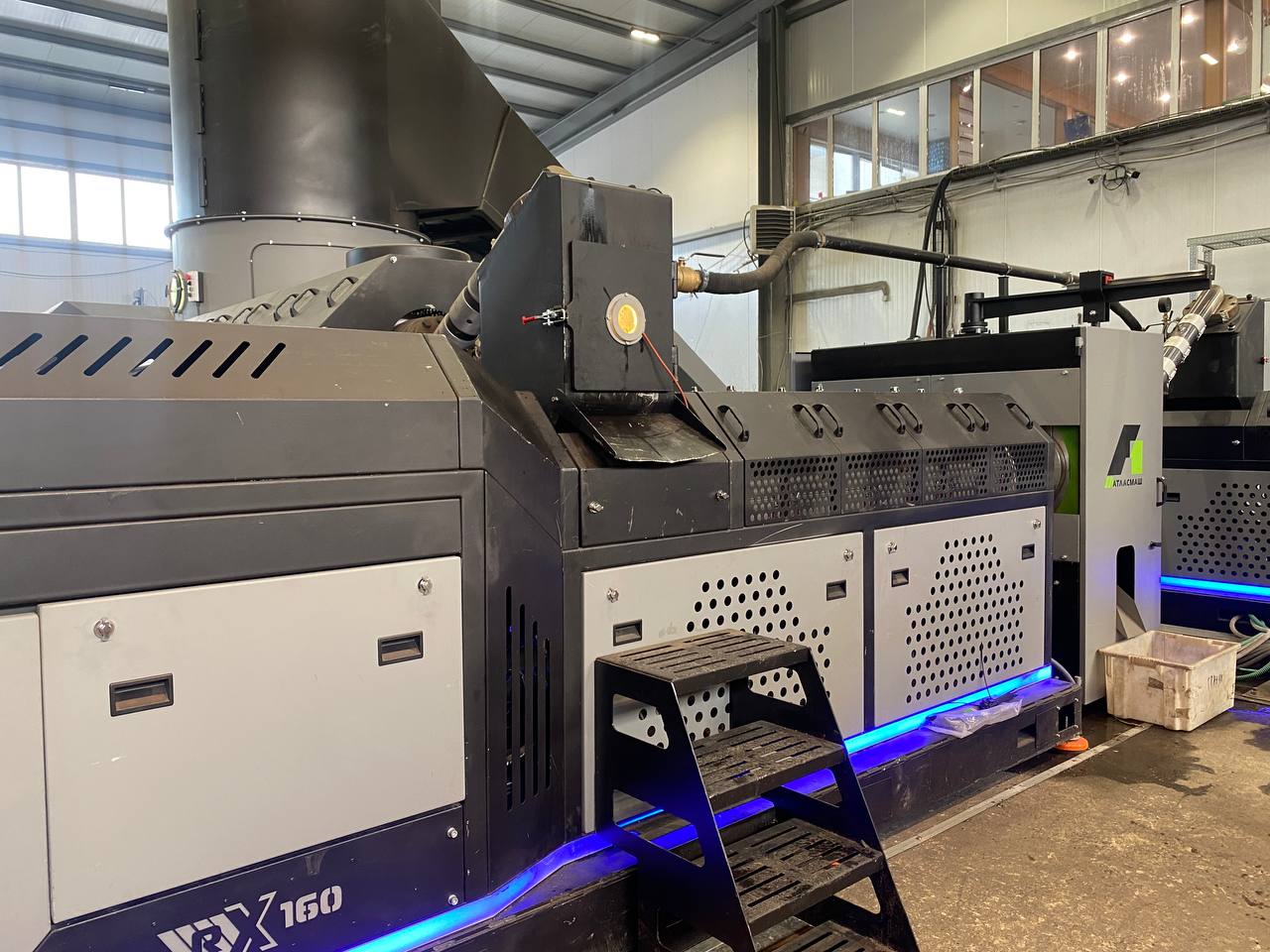
Melt filters F1 from Atlasmash
The solution for melt filtration developed by Atlasmash specialists was a breakthrough for the domestic plastics processing industry. F1 laser filters, manufactured by the company for more than three years, are the undisputed sales leaders in this segment of the Russian market: every year more than 15 systems are installed on different granulation lines in the country. According to Atlasmash, this number exceeds even the total volume of all similar filters produced by Turkish manufacturers combined. The success of F1 laser filters is explained by a number of the following important
features: factors:
- availability. The company managed to develop a fairly simple model to manufacture, which led to a low cost of the system and allows you to keep the cost of a laser filter within the cost of two conventional gate or pistol filters. - durability of filter nets.
Thanks to the special design of the filter elements, the service life of the grids is up to 1 year, which is an absolute record among foreign analogues. Of course, during this period, as the nets become dirty, they are regularly cleaned, but-and this is important — they do not lose their shape and can be used repeatedly, not 2, 3 or 4 times, but dozens of times;
— easy operation. From a week to a month, the filter works non-stop without human intervention. As the grid becomes dirty and the pressure increases, the filter grid in the furnace supplied with the filter is replaced and cleaned. The replacement process takes less than an hour before the extruder starts up again. The design of cleaning knives is simple. We use inexpensive knives that do not require constant replacement — only grinding
every 2-3 months.
- large filtration area
(4000 cm2). For comparison, usually the filtration area in an extruder does not exceed 700 cm2 at a capacity of 500 kg / h, and 1500 cm2 at a capacity of 1000 kg / h..
The solution for melt filtration developed by Atlasmash specialists was a breakthrough for the domestic plastics processing industry. F1 laser filters, manufactured by the company for more than three years, are the undisputed sales leaders in this segment of the Russian market: every year more than 15 systems are installed on different granulation lines in the country. According to Atlasmash, this number exceeds even the total volume of all similar filters produced by Turkish manufacturers combined. The success of F1 laser filters is explained by a number of the following important
features: factors:
- availability. The company managed to develop a fairly simple model to manufacture, which led to a low cost of the system and allows you to keep the cost of a laser filter within the cost of two conventional gate or pistol filters. - durability of filter nets.
Thanks to the special design of the filter elements, the service life of the grids is up to 1 year, which is an absolute record among foreign analogues. Of course, during this period, as the nets become dirty, they are regularly cleaned, but-and this is important — they do not lose their shape and can be used repeatedly, not 2, 3 or 4 times, but dozens of times;
— easy operation. From a week to a month, the filter works non-stop without human intervention. As the grid becomes dirty and the pressure increases, the filter grid in the furnace supplied with the filter is replaced and cleaned. The replacement process takes less than an hour before the extruder starts up again. The design of cleaning knives is simple. We use inexpensive knives that do not require constant replacement — only grinding
every 2-3 months.
- large filtration area
(4000 cm2). For comparison, usually the filtration area in an extruder does not exceed 700 cm2 at a capacity of 500 kg / h, and 1500 cm2 at a capacity of 1000 kg / h..